[***placeholder***]
Let’s say you’ve inherited Grandpa’s ’76 Cadillac El Dorado convertible. It hasn’t seen a mechanic, much less a bottle of Turtle Wax, since who knows when. It’s still loaded with an original 500-cubic-inch V8, along with a lot of your favorite childhood memories. You could sell it. Car collectors will pay to shine it up and put it in a hangar-sized garage. But that’s not what it needs.
It needs to roll. It needs to be seen and appreciated. Still, a car like this takes more than time and commitment. You can’t just work on it. You have to work with it. You’re going to have to pour your love into it week by week, month by month, year by year.
What do you do with the Cadillac?
Residents of Russell will tell you they’ve been facing something that has felt a lot like this. But instead of a Cadillac, it is about the neighborhood itself.
Despite ill socio-economic winds over decades, Russell has kept much of its spirit and character intact. And in recent years, others have noticed. More people have wanted in. Residents knew Russell, the first neighborhood west of Ninth Street, could become a shined-up shell of itself. All the elements were there for gentrification’s grim choice: fight them out or sell out.
But that’s where Russell surprised people. They saw a third option. They essentially told potential newcomers: If you’re willing to see the neighborhood as it is, if you are willing to work with it and not on it, if you are willing to pour your love into it week by week and year by year, you are one of us.
A year and a half ago, I did a group interview with dozens of Russell residents, then did Zoom call with several of them. (One of the questions I asked: If Russell were a car, what would it be? And, yes, the most popular answer by far was: a Cadillac. “Classy, classic, never loses its charm, connections to history. One that keeps the good stuff but has a new twist.”)
We published what we learned in an issue about Russell, in collaboration with Russell: A Place of Promise, which started in 2018 as an “incubator project” between Cities United (focused on public safety) and Metro Government, with financial support from the Community Foundation of Louisville. (In 2024, RPOP became its own nonprofit that operates a community land trust.)
As part of this issue on belonging, I knew I had to check back in with some of the group over Zoom again.


Three of the people from my first call participated again:
Lavel White, grew up in Beecher Terrace in Russell
Ramona Dallum, does community engagement and used to work at the Community Foundation
Cassandra Webb, interim co-executive director of Russell: A Place of Promise
And four new voices:
Frank McNeil, third-generation Russell resident
Vashti Proctor, supervisor at the new Baxter Community Center
Naela Serikali, Russell resident
Treneice Walton, doing work in Russell as a project manager with Urban Strategies
On the call, I revisited four things we talked about a year and a half ago, starting with a multiple-choice question I asked the first time around:
Over the past year or so, Russell has…
- Taken two steps forward
- Taken one step forward
- More or less stayed in place
- Taken one step back
- Taken two steps back
It’s a question I’ve asked a citywide group several times, where it’s common for the majority to say our city has taken a step or two back.
But when I asked the question in Russell, the vast majority — 83 percent — answered that the neighborhood had taken a step forward (with 57 percent picking “two steps forward”). About 14 percent went with “more or less stayed in place,” meaning just 3 percent said Russell had taken a step back.
I asked the group if that still felt true.
Frank: “Steps forward, with caveats. There’s more investment going on in the neighborhood. I can’t say there’s never not been investment in the neighborhood. It’s just been that the tenor of that investment that has historically happened in Russell and in the West End — you have the more additive investment, and then you have the subtractive investment. I remember way back when, where the Sports & Learning Center is now, there was a large proposal to make that basically a methane-distillation plant. That would have been investment, but that would not have been additive investment to the community. There has been, historically, economic forces at play in the community. There’s more now.”
“Russell seems to be getting a little more popular in terms of investors, a mixture of in-town folks and out-of-town folks, folks just trolling the property records. I usually get about a half-dozen postcards, plus phone calls, emails, text messages every week saying, ‘I want to buy your house, no questions asked.’ I had a shoebox full of postcards and mailings from folks, but I’ve stopped collecting them.”
Cassandra: “Residents want investments to come in. They want new things and deserve it. They deserve to have new community centers, deserve to have new infrastructure — whether that’s roads or sidewalks — deserve to have new housing that’s quality and it’s updated to standards. But there’s always the concern of that newness. What does it bring? Does it bring displacement? Does it bring outsiders who don’t necessarily respect or honor the history or the people who have called the neighborhood home? And so, there’s always a balance in having that conversation around investments and gentrification because it’s not just a one-sided thing.”
Naela: “With RPOP, we have the properties we have acquired that we are developing and putting housing up on the Elliott Avenue area. And also REBOUND (a homeownership program through the Urban League), they’re putting up properties for people to be able to purchase. For Russell residents, if you want to stay in Russell, you can purchase those. The possibilities for renters to own their own home, that’s great.
“But we still have a long way to go. We still have high crime. And our young people are struggling. We don’t have very much for them to do in terms of recreation. I don’t know what happened, but we used to have recreational centers, Boys & Girls Clubs, neighborhood places — all these things for young people that extended well into the evening. But now they’ll close at four o’clock, which is when some kids are just getting out of school. I still see things that we need to work through as a community.”
Vashti: “At the Baxter Community Center, we’ve had baby showers, culture celebrations like Kwanzaa, basketball nights. After all the years of it being shut down, I’m very intentional to ensure that, here within Baxter, there is a sense of sovereignty — that folks can feel like they can be themselves here and see themselves here.
“I just invite folks when they come in — I love listening to the stories, those memories here at the center. I’ve seen a lot of photos, trophies and things like that, been doing some searches of old signage that was here before the remodel. I just had a conversation with the Russell family — D’Angelo Russell’s family — because he grew up here, played basketball here (before an eventual NBA career). Young folks, and even all folks, need to see that greatness came from here.”
Lavel: “Farther west, for example, the Shawnee Outdoor Learning Center is going to be a gathering space for receptions, weddings, educational experiences and everything like that. But also, I want to see more job resources come into the West End and the Russell neighborhood, those opportunities so people can be able to afford it.”
Treneice: “When we enroll families for supportive services, we do a full assessment, and then do an assessment annually. And some of the questions we ask are: Do you feel safe in your neighborhood? Do you feel safe in your home? Do you feel safe in your community? Does your child feel safe at school? And never has there been a time where a resident has said, ‘No.’
“It took me a while to understand that with all the things that’s going around in the community. Sometimes, it’s not about what’s going on around you in your communities. It’s about what’s going with you and your home, your children, and how you live your life.”
No. 2: On the Zoom call, I reshared with the group a word cloud I made with their answers to this one: In Russell, is power.
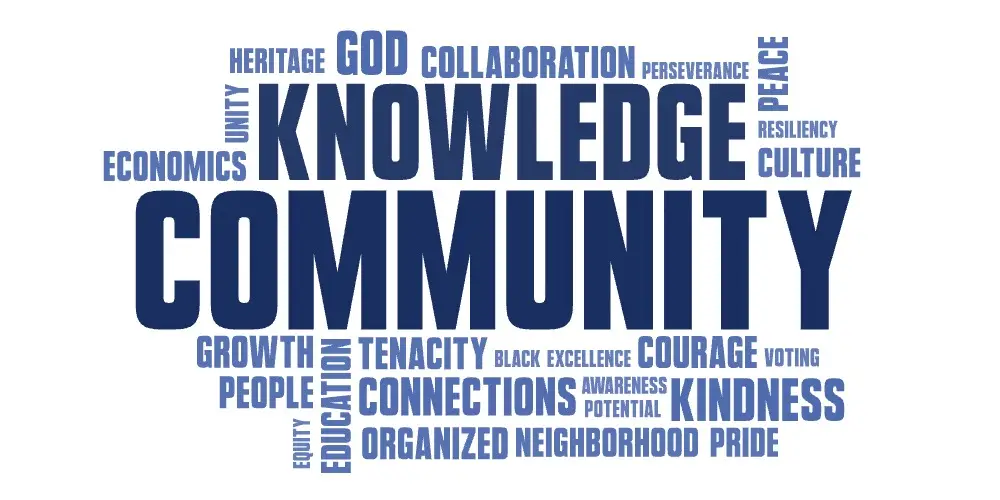
And that word, “community,” had me reading aloud something Ramona said this first time we talked:
“Culturally, as Black folks, we have survived based on our ability to connect and commune with each other. It seems to me it’s harder to maintain that sense of community and close relationships as things are changing.”
I asked her: What has changed since you said that?
Ramona: “That’s interesting that I said that. I still believe that. However, our access to safe spaces — spaces that allow for a community to come together and strategize and reflect and determine for ourselves, as community members, how we make progress — that is still limited.
“I’m reading bell hooks, All About Love, and she talks about love being actions rooted in things like trust, responsibility, care, knowledge. When our systems, our political systems, don’t value those things, but the people who live in a community do, there’s a gap.
“How do you do community transformation without extraction, with the residents of those areas at the forefront and taking the lead in decision-making? I’ve always really been committed to sharing power with and not using power over communities.”
Treneice: “We’ve lately been working with residents to see what their sense of community looks like, what they want the community to be. That sense of community might be in a park, might be in your home, might be bringing small groups of people together. We sometimes wait on our larger systems to say, ‘Hey, this is what community is.’ If we wait on local government, if we wait on politics, it may not happen for years down the road. Sometimes fellowship is right there in your building.”
Cassandra: “I do see hope in a lot of what’s happening. Younger generations, like particularly Millennials or older Gen Z, are trying to create spaces of joy and celebration and community. Oftentimes, not actually having physical spaces hurts the ability to create community. But I think, in the absence of that, what I see is younger generations trying to create these pop-up opportunities, where it’s a positive for elders, for young people, for families to come and gather, things like Hip Hop in the Park, spaces like Alberta Jones Park.
“If we’re looking at the next generation of leaders, I think they’re here, and I think what they need is for folks who are in the older generation, who are still in leadership positions or have this power within community, to be leaning on younger generations and bringing them more into the decision-making, more into the resources, so that they can continue to do some really beautiful work that is needed right now and is going to be needed even more so in the future.”
No. 3: I shared another word cloud from the first interview, with the answers to this question: What’s something about Russell that you seem to worry about a lot more than others?
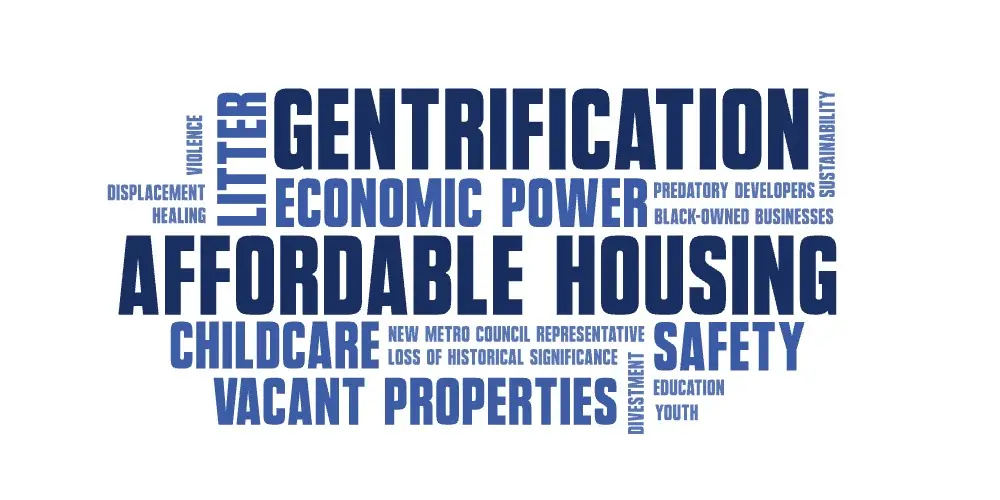
Naela, who wasn’t on the first call, jumped in when she saw that word “gentrification.”
Naela: “I was one of the enumerators during the 2020 Census, and the Russell area — I was so taken aback about how many folks who were living in Russell weren’t Black folks. Russell is becoming popular because it is very close to downtown Louisville. It is prime property, very centrally located, and has that rich history. So people are grabbing this property up. As property value goes up, taxes go up. So we still have this thing about — I mean, Black folks just economically do not make the same as our counterparts. We don’t. So as property taxes go up, we still run into the issue of people not being able to afford the house that they live in now.”
Treneice: “When I hear ‘affordable housing,’ it just kind of makes me cringe, because a one-bedroom unit in Russell is $1,067. And I always hate to say it because it’s only a little less than my mortgage. I have a three-bedroom house in west Louisville. It’s just: Who defines the word affordable? It’s seeming like not too long ago, before COVID, you could get a one-bedroom for $400 or $500.”
Frank: “The word gentrification makes me — I’m not going to say uncomfortable, but it’s kind of one-dimensional. People will say, ‘Oh, if you’re not doing affordable — i.e., subsidized — housing, then you’re gentrifying the neighborhood. Russell, historically, was a mixed-income neighborhood back before the flight of folks from the neighborhood to the suburbs. On the block where I am, my grandfather bought his first house in 1929 when he came to teach at Central High School. The neighbor was an insurance officer at Mammoth Life. We also had folks who worked at Falls City Brewery, which was right behind the house. We had teachers, we had laborers, we had corporate officers — all living in the same block. It would be nice to have that kind of mix back in the neighborhood.
“Basically, how do you make not only Russell but just west Louisville a good investment? And not in terms of return on investment. — but investment for the soul, a good investment for the community, a good investment for the spirit.”
No. 4: To end the call, I read one more of Ramona’s quotes back to the group:
“My kids are grown now, but when I was raising them, they had this community of support around them that understood what they were gonna face in the world. And you have to stay, you have to be a part of that thread that holds all of us together.”
I told her and the others how I’ve thought about that quote so much — about threads. About how a thread can be interwoven and be strong, about how a thread can fray.
Ramona: “It still resonates. We can only do it together. And I think that’s part of who we are. And when I say us, I’m talking about Black people because I’m thinking of the West End being a historically Black space. Community — that’s how we have always survived and thrived, by doing it together. Threads can get weak if they aren’t cared for properly.
“I had the income where I could live anywhere in this city, and I chose to live in the West End, on Southwestern Parkway. It aligned with my values to be in this home here, even though I’m in a food desert, even though I’m seeing what I would describe as over-policing, even though the schools in this part of town might not be the same quality as other parts of town. But I believe in my heart that my ancestors who came before me, who made sacrifices for these West End neighborhoods to be the places where we thrive, then I need to make a sacrifice to figure out: How do we sustain these communities?”
Frank: “When we speak about the word community, and how large that was in the word cloud: You’ll know the strength of a broader community, the feeling of a community, by the organic events, the informal gathering places.
“I live right around the corner from Elliot Park. And in the summertime, that is an informal, happening place. There are folks gathered there. I’m sure there’s probably been tension — there’s probably been shouting, there’s probably been cussing and fussing — but I’ve never seen it where it’s not been a place of gathering, a place of joy.
“And when you have spaces like that, when gatherings like that are not notable anymore, when you no longer look over and think of that as an outlier — then you know you have a community.”