‘The nuance, the complexity, the discomfort and the possibility of what belonging truly means’
Belonging, real belonging, has become the tension and fight of our time.
America is more diverse yet more divided than ever and is a nation that's still wrestling with who counts, who's heard and who's allowed to belong. And as the voices of those long pushed to the margins rise, there's a contingency of those who've always been centered in the story, who now feel like their sense of belonging is slipping into question.
So here we are standing at a crossroads, a critical juncture. We're locked into a moral battle where we must decide whether we will turn toward fear or toward one another.
Belonging isn't soft. Belonging is work. It means challenging the status quo and refusing to accept an America built on exclusion as the only America that's possible.
Belonging is work. It means challenging the status quo and refusing to accept an America built on exclusion...
Truth is, belonging has always been rationed. It’s always required someone to stand outside the circle so that others may feel the warmth within it. And for generations of white men in America, belonging was never a question. It was the air itself.
Monuments to the Confederacy and the generals were erected, and instead of denouncing their treasonous, morally defunct and inhumane calls, schools, highways and public spaces bore their names. God’s face on the stained-glass windows and church programs mirrored their own, and somehow along the way, even working class became conflated with white.
But the American working class has never been singular or exclusively white. Black men, women and immigrants have always been there at its core, doing the work that makes this nation thrive, even while being denied the protections their labor made possible.
When the factories closed and the jobs dried up, what vanished was more than a paycheck. Gone was the ease of assuming the world would bend towards them. What was once effortless belonging for some and a struggle for survival for others came to reveal the exploitation of an economy that treats people as expendable.
Rather than being asked to reckon with what belonging had cost others, white men were offered a counterfeit redemption. Their grief was repackaged into grievance. Their loneliness became resentment and incel culture, and out of that resentment came a machinery of politics built to harm. Policies that made health care unattainable, jeopardized SNAP benefits, criminalized poverty, took a woman’s right to choose, and vilified queer and trans folks; a government that rips apart families and cages immigrants who were only answering Lady Liberty’s call of: bring me your tired, your poor, your huddled masses, yearning to breathe free.
This dispossession was harnessed and unleashed on those who dared to demand belonging. It was easier to hate the “other” than to ask why a system that once centered you now leaves everyone behind. The Black woman whose success buys her entry but not ease — her education opens doors but doesn’t guarantee security. She moves through the world knowing that survival is not the same as arrival.
So this is the American paradox: The people who have always belonged now feel abandoned, while those who never did are told to wait their turn. And those who profit from our division feed us the story that one group's dignity must come at the expense of another's. So the white man's ache and the Black woman's exhaustion never meet, though they are born from the same betrayal.
...this is the American paradox: The people who have always belonged now feel abandoned, while those who never did are told to wait their turn.

Belonging is a practice of democratic maintenance. It’s expanding rights, sharing power and resources, and honoring each community story without erasure.
And then, we can begin to move forward — when economic loss is attributed to extractive systems and not the person who looks different than you, who speaks a different language than you, who loves differently than you or worships differently than you.
If we can hold those truths at once — injury that is real and harms that are unequal — it is only then that we will begin the real labor of belonging together. And that’s what Muhammad Ali did. Born in a country that tried to tell him who he was and what he could be, Ali insisted on belonging on his own terms. A Black man, a Muslim, an American and a citizen of the world, his compassion wasn’t sentimental — it was radical belonging; it was the act of recognizing another person’s humanity. And Ali calling himself the greatest was his way of reclaiming his own humanity in a society that denied it.
For Ali, belonging wasn’t about being included. It was about being seen. He offered the world a different kind of power — the power to stand in truth and to still choose compassion. He was proof that strength and tenderness could coexist; that justice and love are not opposites, but partners.
The real greatness is the capacity to hold both. And that is our calling right now, in this moment — to make sure that belonging is not a privilege for the few, but a practice for all of us.
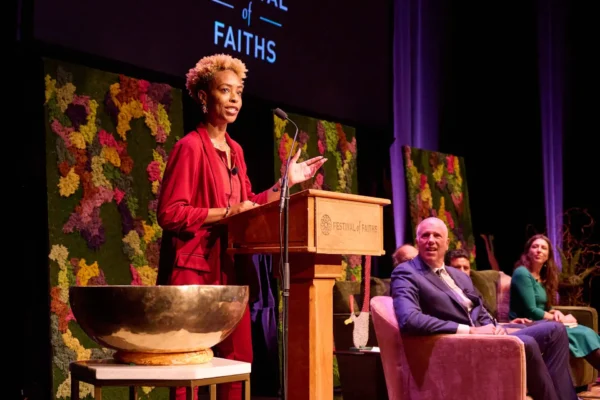
The author delivered this address at the 2025 Festival of Faiths. It’s been edited slightly for length.

