[***placeholder***]
For the past several years, to close out the Festival of Faiths on Saturday morning, I’ve helped facilitate discussions that have covered some of the difficulties we deal with as a city: gun violence, kids feeling disconnected, race in our city since 2020, loneliness, the Ninth Street Divide. Last year, we talked about the theme of belonging through the lens of immigration, in our city of 80,000 immigrants (with one projection estimating that number could double by 2040).
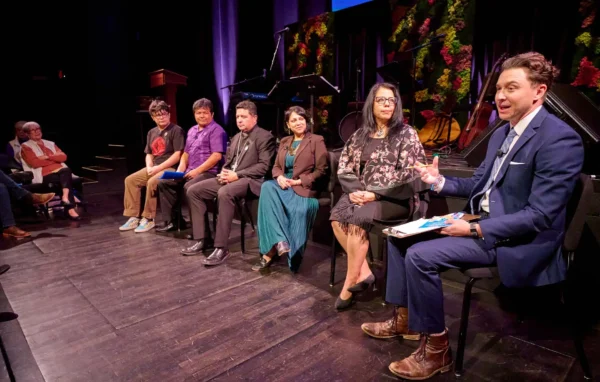
Joining me onstage were:
- Karina Barillas, originally from Guatemala, co-founder and executive director of La Casita Center, a nonprofit that supports Louisville’s Latino community
- Nima Kulkarni, Louisville-based immigration lawyer, first Indian American elected as state representative in Kentucky, co-founder of the New Americans Initiative
- Evelio Menjivar-Ayala, originally from El Salvador, first Salvadoran bishop in the country, serving at the Archdiocese of Washington in D.C.
- The Rev. Elmer Zavala, originally from Honduras, pastor of Preston Highway Hispanic Presbyterian Ministries, co-founder of the community farm La Minga in Prospect (with his son, Galen Zavala Sherby, translating from Spanish to English)
About an hour into the conversation, I mentioned to the crowd that I was bummed we were closing in on our allotted time, that I still had so much I wanted to get to. A few minutes later, festival co-chair Owsley Brown III came up behind me and whispered so only I could hear: “Keep going. We all need to hear this.”
Here are five parts of the discussion that stuck with me.

On what it means to belong
Onstage, I put a question to Bishop Evelio, saying, “Everybody in the crowd this morning, to varying degrees, knows what it feels like to feel left out, to be excluded. Why does being excluded, being made to feel like you don’t belong — why does that hurt so much in the particular way that it does?”
Bishop Evelio: “We have a natural desire to belong. That’s how we were created. If that part of who we are is not fulfilled, then obviously we are going to feel like we don’t matter, like our dignity as a human being is not recognized. So that’s why it is so important to create communities, as Pope Francis said, that welcome, that protect, that promote, that integrate immigrants.
“We all have that need of being welcome in a neighborhood, in a town, in a city, in a nation. This is an inherited need we have — just like eating, like breathing.”
Before the discussion began, I was having coffee in the lobby with Pastor Zavala, who mentioned he had been thinking about why people come to this country. I asked if he could save it for when we were onstage, and, once we were, I invited him to share those thoughts (with his son, Galen, serving as interpreter).
Pastor Zavala (with his son translating): “The reality of this country is that it’s diverse. It’s also true that we try to hide that diversity. The people who come here have been pushed out from every corner of this house we call Earth, from wherever they come from. These borders we’ve created have made it so this natural process of movement doesn’t happen. We say that immigrants have committed the sin of crossing this artificial limit, but this border — that really is our sin. What I try to tell people here in the United States or wherever is that when someone breaks these rules, let us be people who give a warm welcome to those folks who are good people in their vast majority.”
Throughout the morning, I kept making eye contact with the pastor’s son as he was translating, which, in front of the crowd, led me to the unplanned: “Can I ask you a question?”
“Yeah, sure,” he said.
“What are the conversations like that you’re having with your friends right now?”
Galen: “It depends on what friends, right? I work at an Amazon warehouse, so in that context, the overwhelming majority of the people who work there are Spanish-speaking immigrants. People are very aware of fears. They might have family in Miami that have been deported, stuff like that. But then I exist in this other world of friends who are natural-born American citizens. I wasn’t born in this country, but I am a natural-born citizen because my mother is a citizen. And the conversations there are — there is a lot of concern, the way that folks in this room have concern. But it’s one thing to kind of see that reality unfolding, and the kind of visceral fear that people have, and another thing to read about it or to see a video about it.
“If people just say, ‘Oh, that’s too bad that that’s happening, good luck,’ then we will all be passive participants in this atrocity. We’ll just observe it. It is going to require people being willing to put themselves on the line.”
Karina: “I can mention the 17 nonprofits in the city that do this work not because we’re going to get financially rich but because we believe in the American dream. Let us have that American dream. Please don’t make us beg.”
And what it means not to belong
Karina: “As a Latina Louisvillian, I have never felt anything but belonging since the very first day I arrived. There is something about Louisville, the hospitality, but also the complexities that makes us who we are. If you are walking down the street or go in the elevator, somebody tells you about the weather or asks if you saw what happened in the news or says, ‘Oh, I love your dress.’ In Louisville, we look at each other. I’ve been in this city for 32 years, and even though I’ve faced racism and discrimination, at the same time I have experienced the beauty of Louisville itself. How I have grown as a professional, as a person, as a human, in this environment that I call home — this home where I decided to have my babies and teach them and guide them, for them to feel very proud to be Latino and Louisvillian, just like I am.”
Nima: “I felt like a Louisvillian when I started referring to the old Bacon’s Department Store. This discussion about belonging sparked a thought in me: Once you become a Louisvillian, you are a Louisvillian for life. You might move away, you might be traveling around the country, around the world, but you will always, always be a Louisvillian at heart.”
Bishop Evelio: “We have wrestled with the question of what it means to be an American for some time. I would say that, to be an American, you had to embrace the values of this great nation and have a love for this nation. One of the first songs that I started to understand was ‘America the Beautiful,’ which talks about the beauty of nature, the beauty of this country. But it is the people, the beauty of the people, the diversity of this nation. And I think this nation, from the very beginning, was a very diverse nation, — the Native Americans, they were diverse; and then the people who have come to this country and built this great nation have been very diverse. To be an American, you had to have that openness to diversity. You had to cherish the traditions that the people bring and that make the United States a nation that welcomes, that embraces and that integrates everyone who comes here.”
Nima: “America as a country has a very long history of people coming here from other places and building it and refining it and shaping it. Of coming here and making a life for themselves and their families. But we have a very short memory of all of that work and all of that building and all of those contributions that came before. We have to remember our own past, remember what we have done that’s good, that brought us here, and try to avoid or forget the things that keep trying to divide us, which has also been an unfortunate part of our fabric. And I think it’s up to each of us to overcome that urge to look at any one of us as other than ourselves. When we don’t, we have seen the greatest atrocities you can imagine in this country and around the world.”
“By a show of hands, how many people in this room can prove right now that you’re a citizen?”
At one point, I asked Nima, the immigration lawyer, what has changed in her world over the past year or so, and she said she has been advising clients to carry their passports at all times as proof of citizenship.
Nima: “I get calls all the time, from people all across Kentucky, who thought that, when they voted, this administration was going after criminals, gang members, terrorists, the worst of the worst. And they quickly realized this is affecting good people trying to raise their families — about individuals they know, they go to church with, they work with.”
Karina: “If we look at the data of JCPS, the truancy numbers in the immigrant community have gone up, and not because families don’t want to send kids to school. Kids don’t want to go to school because they don’t know if they’re going to come home and are never going to see their parents again.”
Nima: “We’re saying these are criminals because they’re here unlawfully. But that’s not a crime; it’s a civil violation because it’s a matter of having the right paperwork.
“And by a show of hands, how many people in this room can prove right now that you’re a citizen? Do you have anything on you? Your driver’s license doesn’t count.”
Almost nobody in the crowd raised a hand.
Nima: “I have started carrying my passport around, and I advise clients to carry documents. It is so terrifying for people to just go to the grocery store, go to school. You can be on the street and picked up and put into a detention machine that you potentially may never get out of.”
Karina: “I would like to add something. So Nima just asked who has with them this morning something that proves that you are a U.S. citizen. Like a couple of us still raise our hands, yes, we have a passport with us at all times. The ones who didn’t raise their hand, if ICE comes through that door right now, please raise your hand if you think that ICE will come to you and will ask you if you are a U.S. citizen. And I am raising my hand now. For the ones who didn’t raise their hand, why didn’t you, exactly? So those are the things that are not being said. Because, again, why would you think I am undocumented? It’s about the color of your skin or your accent.”
Pastor Zavala (with his son translating): “When parents go out to work, the children, of course, are left with that anxiety.
“People tell me: Pastor, could I put my car in your name?”
“Pastor, could you take care of my children if I’m deported?”
“Pastor, what do I do if the police are knocking on the door of my house or of my car? Do I open it?”
“Pastor, please accompany me to court because I’m very scared.”
“Pastor, I don’t know what to do if I end up being deported.”
Bishop Evelio: “The children — there is collateral damage, and It’s going to stay in this generation of immigrants. It’s like a hurricane. You go to parts of Louisiana, 10 or even more years after the hurricane, you still see the effects. It takes time for people to rebuild the cities or the towns, and so for us, it’s going to also take a lot of time to rebuild confidence, trust in this nation.”
A word cloud of where we're from
Toward the end of the discussion, I shared this word cloud, compiled from the answers of a citywide group I ask questions to every week — and filled out with the countries I heard mentioned by speakers and attendees at the festival.
What main country or two were your ancestors/family from before coming here?
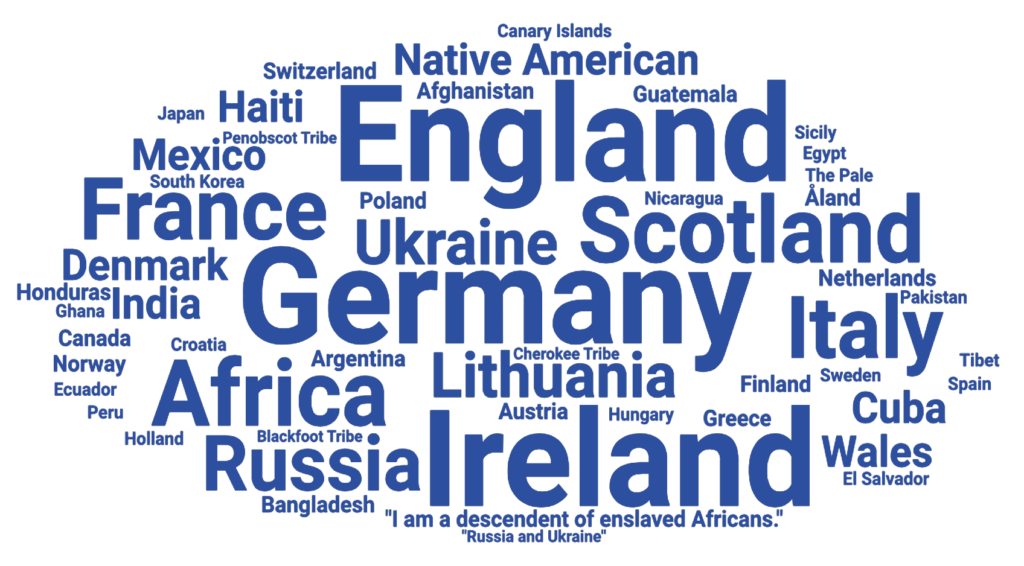
Pastor Zavala (with his son translating): “I see it as us not having a lot of time on the clock to be able to redeem the immigrant community. But I’ve learned throughout my life that, when things get difficult, that might be a signifier that the good things are coming. I believe in people. I believe that, in this moment, the American people have forgotten their origins or their roots. After seeing that slide (of the word cloud), I think of asking the question to the American people: When did you forget? When did you forget that you are an immigrant?”
What superpower would you want in your life right now that you think one of your grandparents possessed?
I almost didn’t ask this question because I didn’t prep the folks onstage for it at all, and I worried nothing would come to mind on the spot. Didn’t want to end with a dud. But over the course of the festival, after listening to three days’ worth of discussion that touched on ancestry, I decided to go for it.
Glad I did.
Pastor Zavala (with Galen, his son, translating): “I have four grandparents that I call the four upright trees. Oaks. These four grandparents of mine unite my mother’s side and my father’s side of the family, and they experienced a very difficult time where five members of the family were murdered very brutally. So it is a tragedy. A month after that tragedy, they had the opportunity to essentially exact vengeance for that killing against those who did the killing. The police who had captured the people who perpetrated this — where they burned these family members alive in their own house — they said, ‘Here, you can take them. Burn them alive if you want.’ The 22 children of this group of grandparents were ready to exact that vengeance. But before that temptation, my four grandparents said: We are not going to do this. If there is a law, let the law punish them. And if there is vengeance to be had, let God do it.’ Well, thanks to that action by my four grandparents, when I go back to my hometown, I play soccer with tons of family.
“See, if we fill ourselves with poison and vitriol against those who are doing us harm, we will arrive at nothing. If we, the brown-skinned people, capture political power and we try to resolve things with vengeance, no, we will get nowhere. We have to be different.
“Thanks to my four grandparents.”
Bishop Evelio: “I grew up in a very, very small village — farmers and people who had a great sense of belonging to the land. A care for creation. My mom, she’s almost 92 years old, and she she still works on the farm, and she’s so proud of growing food, corn, squash, beans. As a bishop, I don’t have time to garden but have great respect for that sense of belonging to the Earth.”
Nima: “My father’s mother, who possessed grace and just had a presence. I don’t know if folks here have met anybody or have anybody in their lives like that, but she would just exude grace, and anybody who came near her in the same room just was calmed and quieted and enfolded somehow, even if they didn’t know her. That grace — I did not inherit that. And I try to remember, in pretty much every situation I find myself, how she would react. Sometimes I forget to remember how she would act. And really, what it all boiled down to was: This was a kind person.”
Karina: “One thing that I’m carrying with me from my ancestors is that everything around me could be horrible and bad, but no one can take away from me the joy of being who I am and where I come from.”
